How Directional Drilling Works in Middle Tennessee Ground
The Central Basin: rock as the default
Nashville sits in the Central Basin, a great oval eroded into flat-lying Ordovician limestone — and that limestone is the metro's working floor, shallow under nearly everything. Soil cover runs thin across the basin: a few feet of clay over rock is the ordinary condition, bare ledge is common, and the deep-soil pockets are the exceptions worth celebrating. For drilling, this flips the standard script: rock competence isn't a contingency, it's the baseline — tooling, rates, reaming passes, and wear all priced for limestone from the first line, with genuine soft cover credited where it exists.
The basin's edge matters too: the Highland Rim stands around it like a wall, and alignments climbing the rim — toward Dickson, up the plateau approaches — change ground class as they climb, trading the basin's limestone for the rim's cherty, gravelly residuum. The quote names where the transition happens.
Karst: the limestone's fine print
Middle Tennessee's rock dissolves, and the basin is textbook karst: caves, cutters and pinnacles at the rock surface, springs, and streams that vanish underground. For the driller, karst means the solid run can meet a void without warning — so the basin's rock work carries soft-ground-style fluid vigilance: watched returns, staged lost-circulation response, conservative pressures, and escalation to engineering review when the ground signals something bigger. Rock skill and karst manners together are the local trade; either alone loses money here.
The sequence, basin edition
Standard bones: One-Call locates plus private designating, potholes on every crossing utility, pilot bore on profile, reaming to roughly one and a half times product, pullback, restoration. Basin bends: rock tooling from the start, pinnacled rock-surface transitions handled at entry and exit where the cover is thin, returns watched for the karst's opinions, and restoration at boom-market quality — this metro photographs its neighborhoods too.
Who owns what you're crossing
Nashville's consolidated metro runs its own ROW machinery; the surrounding cities — Murfreesboro, Franklin, Hendersonville, Lebanon, and the rest — run theirs; county highway departments cover the rural map; and TDOT's utility permits govern the state system and the interstates. The Cumberland brings federal navigation and pool-management review; the scenic-designated reaches of the Harpeth and Duck bring the state's river rules; railroads permit their own corridors. The quote names every owner on your alignment; each one is schedule.
Straight answers
Will you hit rock on my bore?
In the Central Basin, plan on it — that's not a hedge, it's the quoting baseline, with tooling and rates priced for limestone and the soft stretches credited where they genuinely exist. On the rim and the plateau approaches the ground class changes, and the quote names where. Geotech sharpens everything, but here it confirms the rock more often than it discovers it.
How deep do bores run under Nashville streets?
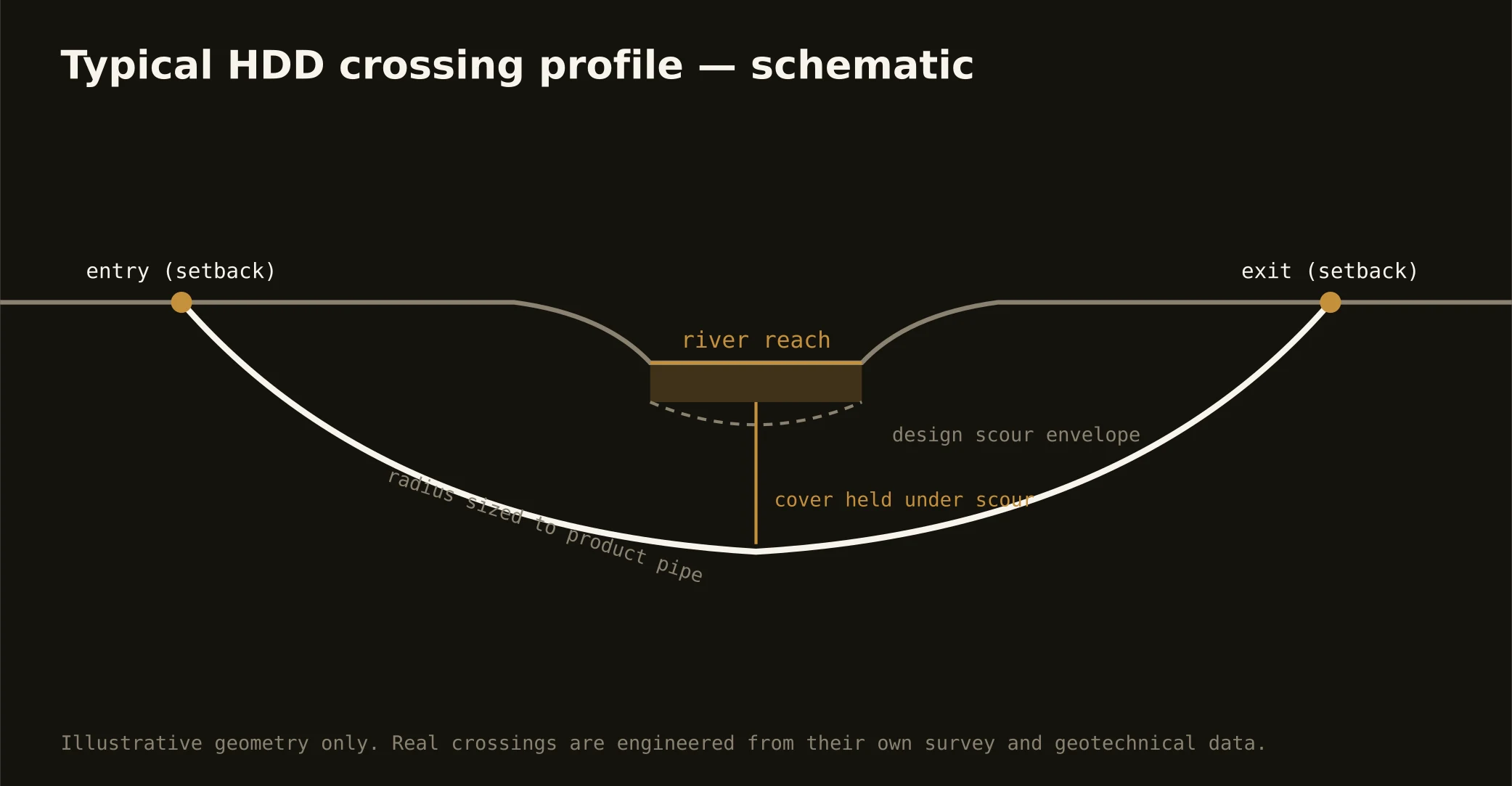
Cover follows the owning authority's standard and sits below everything potholed on the alignment — and in this metro the bore is frequently in rock at that depth, which is fine: limestone holds a bore beautifully. River and rail crossings run deeper on their own engineering. The bore plan states your number.
Does karst make drilling here risky?
It makes vigilance non-optional, which is different: the basin's voids are a known feature with a known playbook — watched returns, staged response, conservative pressures, engineering escalation. The metros that scare drillers are the ones that pretend their ground away; this one advertises its limestone on every road cut, and the trade here respects it accordingly.
Ready to put a number on a real crossing? Send the scope — a person prices it.